
Monday, November 28, 2011

Wednesday, November 23, 2011

Rafael Osuna

CNN

The original Rafa: The best tennis player you never knew

By Paul Gittings, CNN

November 23, 2011 -- Updated 1549 GMT (2349 HKT)
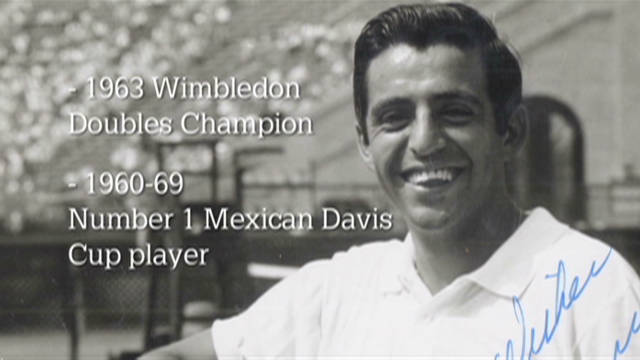
Rafael Osuna will always be remembered for his outstanding play and sportsmanship. Rafael Osuna will always be remembered for his outstanding play and sportsmanship.


STORY HIGHLIGHTS

  • Rafael Osuna is Mexico's greatest ever tennis player
  • He was tragically killed in an air crash in 1969 aged just 30
  • Osuna was the first player from Latin America to be World No. 1
  • He won the U.S. Open in 1963 and three grand slam doubles titles

(CNN) -- When Mexican Airways Flight 704 crashed into the mountains near Monterrey on June 4, 1969, it claimed the lives of 79 people including a national hero and one of the greatest players to wield a tennis racket.

He had carried the hopes of his country for a decade until his life was tragically cut short, just days after leading Mexico to an epic victory over all-conquering Australia in a Davis Cup tie, the crowning achievement of a remarkable career.

He was a grand slam winner, a former world number one and one of the most innovative doubles players in the sport's history.

Rafael Osuna Herrera was, quite possibly, the greatest tennis player you never knew, a compelling and inspirational figure, but more than 40 years since his death he has been largely forgotten.
Tennis' first Rafa

Perhaps this is because Osuna was at his peak during the 1960s, before the blanket television coverage of grand slams and major competitions such as the Davis Cup.

Clips of him in action are mostly in grainy black and white, but even to the non-expert eye his style of play and breathtaking speed on the court stood out.

His modern namesake Rafael Nadal batters opponents into submission with grueling baseline rallies, but Osuna used his lightning-fast reactions to shorten points, rushing to the net behind his service to pull off unlikely volleyed winners.

He was such a popular player, always with such good sportsmanship and always with a smile.
Bud Collins

"He was the quickest of his era," recalled legendary tennis broadcaster Bud Collins, who commentated on many of the Mexican star's biggest matches, including his 1963 U.S. Open final win over Frank Froehling on the grass of Forest Hills.

Osuna's nephew Rafael Belmar said his uncle had developed his quickness about court from his early days as a junior table tennis player, when forced to run around the table to reach the drop shots of canny older opponents.

Belmar also recalled a chance conversation with karate legend Chuck Norris, who he met while studying in the United States.

Norris was telling a story about the only two men he knew who could catch a fly with two fingers. One was the martial arts and film legend Bruce Lee, the other was Belmar's uncle Rafael.

"I was amazed," Belmar told CNN. "But in a way not surprised, he could intercept an opponent's drop shot before it bounced!"

We had to tear his game apart, but he could move like a God
George Toley

Osuna, who came from a middle-class Mexican family, studied at University of South California (USC), going there as a raw freshman and developing his game under the tutelage of coach George Toley.

"Everything he did on court was bad fundamentally, in part because he was such a natural and could get away with it," Toley wrote in a book about his experiences at USC.

"We had to tear his game apart, but he could move like a GOD!"

Osuna's first notable success came at Wimbledon in 1960 when he won the doubles with his USC roommate Dennis Ralston, the first unseeded pair to achieve the feat.

It was the catalyst for an outstanding doubles career, which saw him claim further grand slam titles at the U.S. Open in 1962 and Wimbledon in 1964 with his compatriot and Davis Cup partner Antonio Palafox.

Maybe Mexico is not so good at celebrating our heroes
Rafael Belmar

Their doubles combination helped Mexico to the Davis Cup final in 1962, but they were beaten by one of the greatest Australian line-ups of all-time, spearheaded by Rod Laver.

Collins believes that had Osuna maintained his college partnership with Ralston, his success might have been even greater in grand slams, but it was with Palafox that the pair experimented with a new formation that is commonly used today.

When serving, the other player would straddle the center line, keeping hunched down low to avoid being hit, before springing up to intercept their opponent's return.

It's called the "I-formation" but Collins said Osuna and Palafox were the first to use it.

Such unconventional tactics were Osuna's hallmark and played a major part in his only grand slam singles success in 1963.

Froehling was renowned for his big serve-and-volley game. Osuna confounded him by standing way back behind the baseline and then floating back lobbed returns.

An easy 7-5 6-4 6-2 victory followed and a place is tennis history as the first and only grand slam champion from Mexico.

The man surpasses his achievements
Manuel Santana

It earned Osuna the International Tennis Federation's world No. 1 ranking at the end of 1963, the same year he graduated from USC with a degree in business administration.

In the pre-Open era, a professional circuit ran in opposition to the regular tennis calendar, with players like Laver joining the paid ranks after accumulating grand slam titles.

Osuna, however, spurned the opportunity and took a job with the tobacco giant Phillip Morris, while still playing full time.

"He was offered $120,000 in 1962 by Jack Kramer (who ran the pro tour) but turned it down," claimed Belmar.

"My uncle had houses in Beverly Hills, in Mexico City and the Venezuelan capital of Caracas, so money was clearly never an issue."

Keeping his amateur status meant Osuna could continue to play at Wimbledon, where with Palafox he won his final grand slam doubles crown and became the first and only Mexican to grace the cover of the official tournament program in 1964.

Osuna reached the semifinals of the U.S. Open the following year, and when the Olympic Games came to Mexico in 1968 he won the exhibition tournament in both singles and doubles.

Tennis did not become an official medal sport until the 1988 Games in Seoul but the Osuna family still hold dear the gold medals he was awarded.

Approaching the end of his career at the top, Osuna continued to play Davis Cup and on the clay in Mexico City summoned up one last giant effort as 17-time winners Australia visited for a zonal final.

Osuna won all three points for Mexico in a 3-2 victory, including a crucial singles win over Australian No. 1 Bill Bowery, again deploying unusual tactics in the fourth set to prevent his opponent from volleying before breaking his service for the final time.

No-one can know if Mexico might have progressed further -- the team lost in the next round to Brazil after Osuna had lost his life in one of his country's worse airline disasters.

Since his death, Osuna has been honored, with a statue erected and a tennis stadium in Mexico named after him.

The ultimate accolade came in 1979 when he was inducted into the Tennis Hall of Fame, but in recent years, with Mexicans struggling to make an impression on the courts of the world, his place in the national consciousness has waned.

"Maybe Mexico is not so good at celebrating our heroes, he has become an obscure figure from the past," Belmar said.

Belmar tried to follow in his uncle's footsteps, playing collegiate tennis, while others such as top 10-ranked Raul Ramirez were also inspired by his achievements.

Spanish player Manuel Santana, the 1966 men's Wimbledon champion, perhaps best sums it up: "The man surpasses his achievements."


CNN TV | HLN | Transcripts

Tuesday, November 15, 2011

Monday, October 24, 2011

AGING AND FITNESS

In a study published last year in the journal Deutsches Ärzteblatt International, Dieter Leyk and colleagues crunched finish-time data for more than 900,000 marathon and half-marathon finishers in German races, with ages ranging from 20 to 79.

The results were startling: No significant age-related decline in performance appeared before the age of 55. And even beyond that age, the decline was surprisingly gentle. In the 65-to-69 group, a full 25 per cent of the runners had times that would have ranked as above average among 20- to 54-year-olds.

Crucially, the runners in the study trained a similar amount (typically three to four times a week, for about an hour at a time) no matter what their age.

The conclusion is clear, the study authors write: “Performance losses in middle age are mainly due to a sedentary lifestyle rather than biological aging.”

Of course, few people manage to sustain even that fairly moderate level of exercise into their 40s and beyond. There are numerous possible explanations for the drop-off, including the time pressure of raising families and increased responsibilities at work. But a more subtle contribution may come from a gradual decline in the “intrinsic drive” to exercise.

When mice are left to their own devices in a cage with an exercise wheel, the amount they choose to run declines with age, long before any changes in their physical capacity are evident. While it’s not clear what determines this “intrinsic drive,” research by Mark Davis and colleagues at the University of South Carolina has suggested that it’s linked to levels of mitochondria in the brain.

Mitochondria are the “power plants” that provide energy to cells and muscle fibres. It has long been known that aerobic exercise boosts levels of mitochondria in your muscles, but a study just published by Dr. Davis’s group shows for the first time that aerobic exercise also stimulates the growth of new mitochondria in the brain.

This research remains in its preliminary stages, but the implication is that the brain responds to training like a muscle – and if it gets out of shape, it too is susceptible to fatigue and more likely to opt to stay on the couch. Regular exercise, on the other hand, doesn’t just preserve your ability to exercise as you get older; it also preserves your desire to exercise.

Alex Hutchinson blogs about research on exercise at sweatscience.com. His new book – Which Comes First, Cardio or Weights? – is now available.

Friday, July 8, 2011

Raonic - Hip Surgery

image Canadian No. 1 Milos Raonic is expected to return to the practice courts in six weeks after undergoing hip surgery 5 July in Vail, Colo.

The 20 year old sustained the hip injury during his second-round match against Gilles Muller at Wimbledon and retired from the encounter after playing five games. He subsequently withdrew from Canada’s Davis Cup tie versus Ecuador.

ATP

Wednesday, June 22, 2011

Sunday, June 19, 2011

THE GOSPEL ACCORDING TO ST. JOHN - THE BLASPHEMIST

WIMBLEDON, England — The pastor of a Baptist church near this tabernacle of tennis has posted what could be the perfect topic for his Sunday sermon on the eve of the 125th Wimbledon Tennis Championships at the All England Club.

image THE NEW YORK TIMES

Wednesday, June 8, 2011

Cat Gut ...... Not!

A firm in Norfolk collects cow intestines by the bucketful from local abattoirs and turns them into the kind of natural gut strings favoured by many of the world's top tennis players.

"It takes about four cow's guts to string the average racquet," production manager Rosina explains.

To produce the strings, the cow guts are cleaned and cut into 40ft strands before being chemically treated to preserve them.

Each string is made up of 15 individual strands which are spun very tightly together to coalesce them, before being dried out in a humid room to prevent cracking.

It is a painstaking process that takes six weeks from start to finish, but according to Rosina, it is worth the wait.

"With synthetic string, once it's in the racquet and is hit by a ball, it will stretch and stay stretched, but because gut has a natural memory, it always tries to return to its original form, therefore absorbing the shock a lot more and reducing the risk of tennis elbow."

The company, which has been plying its unusual trade for more than 100 years, also uses the same techniques to produce gut strings for harps and other early instruments.

BBC

Saturday, June 4, 2011

Nestor-Mirnyi win Paris

Canadian Daniel Nestor retained his Roland Garros doubles crown as he and Belarusian partner Max Mirnyi won their first Grand Slam title together by defeating South Americans Juan Sebastian Cabal and Eduardo Schwank 7-6(3), 3-6, 6-4 in Saturday’s final in Paris.

"It's unbelievable. I never get too old," declared Nestor. "[The] biggest goal in my career is winning Grand Slams. They're all special for different reasons. Every time you win with a new partner, that first one is an amazing feeling. Today is no exception."

Added Mirnyi, "I think any Grand Slam is a special win, but particularly for a new team it's a very important hump to get over. We knew on paper we're capable of playing well together. [But] up until you produce a result, you never know. Now having won a Grand Slam we know what we need to work on. We hope to maintain the level and hopefully get many more important wins."

World No. 3 Nestor lifted the winners’ trophy last year with Serbia’s Nenad Zimonjic, and had also triumphed in 2007 with former long-time partner Mark Knowles of the Bahamas. The 33-year-old Mirnyi also won the title for the third time, having won back-to-back trophies with Jonas Bjorkman in 2005-2006.

Tour-level debutant Cabal and partner Schwank had been the surprise of the tournament on their way through to the final, including taking out World No. 1 pairing Bob Bryan and Mike Bryan in the semi-finals. The Colombian-Argentine duo carried their good form into the final as they pushed second seeds Mirnyi and Nestor to a first-set tie-break before surrendering the opener.

ATP

Wednesday, May 25, 2011

Are You Rotten To The Core

With well-built cores, ATP World Tour players not only enhance performance but guard against injury by stabilising an integral part of their bodies. When players undertake a strengthening program, they quickly learn that that there’s a lot more to core stability thant good-looking abs.

“People mistakenly picture a guy in a Calvin Klein commercial with washboard abs,’ says Todd Ellenbecker, Director of Sports Medicine for the ATP World Tour. “The core is really an all-encompassing cylinder, including the abdominal musculature, the muscles on the side of the body like the obliques, lower back muscles, some of the muscles in the pelvic floor that go all the way into the pelvis, and as high up as the muscles that stabilize our scapulae. That’s a very large area of musculature.” 

ATP players spend a sizable amount of time off court building up their mid-sections to help combat future injuries. By bolstering the core it protects the spine, one of the most frequently injured areas among elite-level tennis players. “ATP players like to strengthen their core to minimize or reduce the risk of injuring their spines. It makes the spine more resilient against injury,” Ellenbecker says.

In addition to averting injuries, strong cores act as a performance enhancer on court. When you see Rafael Nadal hit a punishing forehand, or Novak Djokovic rip a backhand, the immediate thought is ‘his arm is really strong’. While that‘s true, it’s not the determining factor in the power they generate, says Ellenbecker. “We know that most of the power we get in tennis, 54%, comes from our legs and the core.”

The core plays a key role in a player’s ability to hit booming shots, as well as striking the ball with consistency, transferring power from the legs to the shoulders. “You have this very strong transference from the lower body to the upper body, and the core is exactly what fits in between that,” explains Ellenbecker. “By having a strong core then, they’re able to harness that power from the legs, transfer that into the upper body, and then ultimately into the ball and the racquet.”

Boosting Core Strength

The exercises below are great for ATP World Tour players and club players because they can be done at home or on the road.

Arm and Leg Extension ('Bird Dog')

This exercise strengthens lower-back muscles.

1. Lay face down on an exercise ball.

2. Place your arms, knees, hands and legs on the ground.

3. Extend your left arm and right leg, holding for two seconds, then return to the starting position.

4. Extend your right arm and left leg, and hold for two seconds, returning back to the starting position.

5. Go back and forth between the diagonals and try to keep yourself stable on top of the exercise ball.

Ellenbecker Says: “A lot of players already have strong abdominals, but where they’re particularly weak many times is in the low-back muscles. There’s a certain balance of strength that has to occur between the abdominal muscles and the low back muscles… otherwise it can leave them vulnerable to injury.” 

Seated Ball Rotation

This exercise works all of the core muscles, simulating forehands and backhands. It requires a partner.

1. Sit on an exercise ball with your feet on the ground, shoulder-width apart.

2. Using a four-to-six pound medicine ball, throw the ball to your partner with both hands as if you were hitting a forehand.

3. Mix up your simulation with cross-court and down-the-line patterns in sets of 30 seconds.

4. Switch to the backhand side, and repeat steps above.

Ellenbecker Says: “The advantage is that there is a lot of rotation. What we think about is that almost every shot, every movement we perform in tennis, involves a significant amount of rotation in the lower back. So if we use a rotation movement, a concept called ‘specificity,’ you actually train the body in the specific way it’s used on court. Players enjoy it, which is why you see a lot of them doing it.”

The Plank, The Plange, TV Watching

This exercise improves your core stability.

1. Assume a position on both elbows and your toes, maintaining a straight alignment.

2. Look straight down at a point slightly in front of you.

3. Maintain the pose for 30 seconds, doing several sets.

A Side Plank is a beneficial variation of the exercise, working the obliques and other side muscles.

1. Lie on your side and brace yourself on your right elbow and the outside of your right foot, again keeping a straight alignment.

2. Maintain the pose for 30 seconds, doing several sets.

3. Switch to your left side and repeat.

Ellenbecker Says: “This is really good for working the obliques, which helps to rotate the body on court.”

Core Myths

“In order to have a strong core, you have to go to a gym and use all sorts of fancy machines.”

Ellenbecker Says: “That’s actually quite far from true, as we’ve found it’s better to use things like the Swiss ball, medicine balls, and functional movements, which are more effective in many cases than machines. When using a machine, you’re only working in one direction.”

“A few sets of 10 sit-ups a day is enough for a strong core.”

Ellenbecker Says: “That’s just working the abdominals. You may look good, having nice-looking abs, but you won’t have the injury prevention protection that you would if you worked all areas of the core.”

“When I do sit-ups, I need my feet held to the ground by another person or a couch.”

Ellenbecker Says: “What we’ve found is that when you have your feet in a fixed manner, it actually ends up using more of your hip flexors than your abdominals. What we recommend is that the feet are just on the ground or even off the ground so that it takes the hip flexors out of the exercise. Very few people, especially athletes, have weak hip flexors. You don’t want to use the hip flexors to substitute for a weak core.”

ATP

Thursday, April 28, 2011

RAONIC INTO QUARTERS

(AFP) ESTORIL, Portugal

Canadian Milos Raonic reached his first career quarter-final on clay with a 6-3, 6-3 defeat of Portugal's Joao Sousa at the ATP-WTA Estoril Open here on Thursday.

Raonic, seeded fifth and ranked 26th, kept his level high on the clay as he prepares to play as a seed at Roland Garros starting May 22.

The youngster who began the season just inside the Top 200 before breaking through with a title in San Jose and final a week later in Memphis, will Friday face the French fourth seed Gilles Simon.

Tuesday, April 26, 2011

TOMMY HAAS

GELSENKIRCHEN, Germany, April 26 (Reuters) - Former world number two Tommy Haas made his comeback on Tuesday after missing 14 months through injury when he competed in the doubles event at the Munich Open.

The 33-year-old German, who had reached his career-high ranking in May 2002 and played in four grand slam semi-finals, has won 12 singles titles but has been plagued by injuries for much of his career.

Haas, who has also taken on U.S. nationality, partnered close friend and Florida neighbour Czech Radek Stepanek but lost to Sweden's Simon Aspelin and Australian Paul Hanley 2-6 6-3 10-8.

"I would have also liked to play in the singles but I have not reached that point yet," Haas told reporters. "It was good experience but we came up a bit short."

He had last played on Feb. 22, 2010 at the Delray Beach International, following which he underwent hip and elbow surgery.

(Writing by Karolos Grohmann, Editing by Mark Meadows and Pritha Sarkar; To query or comment on this story email sportsfeedback@thomsonreuters.com)

Thursday, April 21, 2011

PLAYERS AND THEIR STRINGS

Here are the strings the world’s top tennis players, (and a few recently retired players), are using in their rackets, together with the rackets they’re using, and the tensions, (in lbs), they most commonly string at.  These tensions are known as ‘Reference Tensions’, and are the tensions the pros will hit with when they arrive at a tournament.  Having seen how the racket feels at the Reference Tension, they’ll then, if necessary, take the tension up or down a couple of pounds at a time until the get the feel they’re looking for.  Things such as court surface, temperature, altitude, as well as their next opponent, will all contribute to any change required, but everything will start from the Reference Tension.

Where two tensions are shown the first is the tension of the main strings, and the second is the tension of the cross strings.

Where hybrid stringing is shown, the first named string is used for the main strings, and the second named is used for the cross strings. For example, Australia’s Lleyton Hewitt uses Babolat VS Team for his main strings, and Luxilon Big Banger Alu Power for his cross strings, whereas Sweden’s Joachim Johansson uses Luxilon Big Banger Alu Power for his main strings, and Babolat VS Touch for his cross strings.

Latest Update: Hopman Cup/Doha/Sydney/Australian Open - January 2011

Mario Ancic Yonex RDS 002 Tour

Luxilon Big Banger Original 62lbs

Marcos Baghdatis Tecnifibre T-Flash 315 Speedflex

Tecnifibre X-One BiPhase 46/51lbs

Tomas Berdych Head YouTek Radical MP

Luxilon Big Banger Alu Power 55lbs

James Blake Wilson Six.One Tour BLX

Luxilon Big Banger Alu Power 68lbs

Bob Bryan Prince EXO3 Rebel

Prince Natural Gut/Luxilon Big Banger TiMo 51/47lbs

Mike Bryan Prince EXO3 Rebel

Prince Natural Gut/Luxilon Big Banger TiMo 48/45lbs

Guillermo Canas Wilson nPro nCode

Wilson Enduro Tour  55lbs

Jennifer Capriati Prince Tour Diablo

Babolat VS Touch/Luxilon Big Banger Alu Power 51/48lbs

Juan-Ignacio Chela Babolat Pure Storm Team

Tecnifibre Spinfire Maxi Power 58lbs

Marin Cilic Head YouTek Radical MP

Babolat VS Touch 61lbs

Kim Clijsters Babolat Pure Drive Team

Babolat VS Touch 58lbs

Guillermo Coria Head Microgel Radical

Toalson Cyber Blade Tour 52lbs

Lindsay Davenport Wilson [K]Tour

Wilson Natural Gut 63/64lbs

Nikolay Davydenko Dunlop Biomimetic 200 Plus

Polystar Energy 51lbs

Juan Martin del Potro Wilson [K] Six.One 95

Luxilon Big Banger Alu Power 62lbs

Novak Djokovic Head YouTek IG Speed Pro 18×20

Head Natural Gut/Luxilon Big Banger Alu Power Rough 55/52lbs

Elena Dementieva Yonex RDiS 100 Mid Plus

Luxilon Big Banger Alu Power 52/48lbs

Roger Federer Wilson Six.One Tour BLX

Wilson Natural Gut/Luxilon Big Banger Alu Power Rough 48.5/44lbs

David Ferrer Prince EXO3 Tour

Luxilon Big Banger Original 51lbs

Juan Carlos Ferrero Prince EXO3 Tour

Luxilon Big Banger Original 53/51lbs

Richard Gasquet Head Microgel Extreme Pro

Luxilon Big Banger Alu Power 58lbs

Gaston Gaudio Wilson nSix-One 95

Toalson Cyber Blade Tour 59.5lbs

Robby Ginepri Babolat Pure Storm Team

Babolat Pro Hurricane/Babolat VS Team 64lbs

Fernando Gonzalez Babolat Pure Storm Team

Babolat Pro Hurricane 60lbs

Sebastien Grosjean Head Microgel Prestige Mid

Babolat VS Touch 51lbs

Tommy Haas Head YouTek Prestige Pro

Babolat VS Team  75lbs

Daniela Hantuchova Prince EXO3 Tour

Babolat VS Touch 58lbs

Justine Henin Wilson Tour BLX

Babolat VS Touch 59.5lbs

Tim Henman Slazenger NX One

Luxilon Big Banger TiMo/Babolat VS Team 62lbs

Lleyton Hewitt Yonex RDiS 100

Babolat VS Team/Luxilon Big Banger Alu Power 56lbs

Martina Hingis Yonex RQS-11

Yonex Polyester/Babolat VS Team 49/44lbs

John Isner Prince EXO3 Black

Tecnifibre Pro RedCode 62lbs

Ana Ivanovic Yonex Ezone

Luxilon Big Banger Alu Power    54lbs

Jelena Jankovic Prince O3 Speedport Pro White

Luxilon Big Banger Alu Power/Prince Natural Gut    64lbs

Joachim Johansson Yonex RDS 001 Mid Plus

Luxilon Big Banger Alu Power/Babolat VS Touch 67lbs

Stefan Koubek Wilson nSix-One 95

Isospeed Professional 62lbs

Gustavo Kuerten Head Liquidmetal Prestige Mid

Luxilon Big Banger Alu Power 56lbs

Svetlana Kuznetsova Head Extreme Pro

Luxilon Big Banger Alu Power 57/55lbs

Ivan Ljubicic Head YouTek IG Extreme Pro

Babolat Pro Hurricane 69lbs

Michael Llodra Wilson BLX Pro Tour

Babolat VS Team 52lbs

Paul-Henri Mathieu Wilson [K]Blade 98

Luxilon Big Banger Alu Power 62lbs

Amélie Mauresmo Head Microgel Radical MP

Babolat VS Touch 54lbs

Jürgen Melzer Dunlop 4D 300 Tour

Isospeed Professional 75lbs

Gaël Monfils Prince EXO3 Rebel

Luxilon Big Banger Alu Power 57/55lbs

Carlos Moya Babolat Pure Drive Team

Luxilon Big Banger Original 60lbs

Andy Murray Head YouTek Radical Pro

Luxilon Big Banger Alu Power Rough/Babolat VS Team 62lbs

Anastasia Myskina Head Liquidmetal Instinct Tour

Luxilon Big Banger Timo 56/52lbs

Rafael Nadal Babolat AeroPro Drive GT

Babolat RPM Blast 55lbs

David Nalbandian Yonex RDiS 100

Luxilon Big Banger Original 64lbs

Jiri Novak Völkl Tour 10 Mid Plus

Luxilon Big Banger Alu Power 64/62lbs

Flavia Pennetta Wilson Blade 98 Pink BLX

Wilson Natural Gut 63lbs

Nadia Petrova Babolat AeroStorm

Luxilon Monotec Supersense 62lbs

Mark Philippoussis Head i.Prestige

Babolat VS Team 75lbs

Mary Pierce Yonex RD Ti-80

Luxilon Big Banger TiMo 65lbs

Tommy Robredo Dunlop 4D 300

Luxilon Big Banger Original 52lbs

Andy Roddick Babolat Pure Drive Roddick

Babolat Pro Hurricane Tour/Babolat VS Team 73/61lbs

Greg Rusedski Dunlop Aerogel 200

Babolat VS Team 48lbs

Marat Safin Head Microgel Prestige Mid

Luxilon Big Banger Alu Power 60lbs

Dinara Safina Babolat AeroPro Drive GT

Babolat RPM Blast 68/64lbs

Fabrice Santoro Head Flexpoint Radical Tour

Tecnifibre X-One Biphase 60lbs

Patty Schnyder Head Liquidmetal Prestige Mid

Kirschbaum Touch Turbo 57lbs

Maria Sharapova Head Prototype

Luxilon M2/Babolat VS Team 62lbs

Robin Soderling Head YouTek Radical MP

Luxilon Big Banger Alu Power 56lbs

Paradorn Srichaphan Yonex Ultimum RD Ti-80

Luxilon Big Banger Alu Power/Babolat VS Touch 64lbs

Radek Stepanek Bosworth Custom

Pacific Prime Gut 55/53lbs

Paulo Suarez Prince O3 Tour

Prince Tournament Nylon 65lbs

Janko Tipsarevic Tecnifibre T-Fight 325 VO2 Max

Tecnifibre BlackCode 57/55lbs

Viktor Troicki Prince Ozone Tour

Prince Poly EXP

Jo-Wilfrid Tsonga Babolat AeroPro Drive GT

Babolat VS Team 59.5lbs

Nicole Vaidisova Yonex RDiS 100

Luxilon Big Banger Ace (Tension Not Available)

Kristof Vliegen Tecnifibre T-Fight 325 VO2 Max XL

Tecnifibre BlackCode 44/38.5lbs

Serena Williams Wilson [K]Blade Team

Wilson Natural Gut 65lbs

Venus Williams Wilson Blade Team BLX

Wilson Natural Gut 68lbs

Caroline Wozniacki Yonex VCore 100S GT

Babolat Revenge/Babolat VS Team Natural Gut 57lbs

Vera Zvonereva Prince EXO3 Black

Gamma Zo Sweet 57/60lbs

from:      COLINTHESTRINGER.COM

Tuesday, April 19, 2011

RAONIC A SEED IN PARIS

Milos Raonic is guaranteed of being seeded at the second Grand Slam of the year.

The Canadian tennis sensation moved up to 28th in the world rankings Monday, meaning he will be among the seeded players for the French Open in Paris next month. Thirty-two players are seeded at the tournament, which starts May 17.

Raonic, a 20-year-old from Thornhill, Ont., has jumped 128 spots in the rankings since the start of the year. He was ranked 156th at the end of 2010.

Fifteenth-seeded Raonic will face Radek Stepanek of the Czech Republic in the first round of the Barcelona Open Tuesday.  Last week he was ousted by Spain's David Ferrer in the third round of the Monte Carlo Masters in Monaco.

In doubles play Tuesday, Raonic and Nicolas Almagro of Spain lost 6-2, 6-4 to Xavier Malise of Belgium and Alexandr Dolgopolov of Ukraine in the first round.

QMI AGENCY

WIMBLEDON

The singles champions at Wimbledon this year will each receive 1.1 million pounds ($1.8 million), a 10 per cent increase from last year.

The All England Club chief executive Ian Ritchie announced Tuesday the total prize fund for the 125th championships is going up by 6.4 per cent to 14.6 million pounds ($23.8 million).

Because the British pound has strengthened since last year, the increase is even larger when counted in dollars.

"Leading international sports events, such as Wimbledon, are all about the quality of the players on show," All England Club chairman Philip Brook said. "It is important that we offer prize money which suitably rewards the players both for the box office appeal they bring to the event and for their supreme performances on court."

Last year, prize money for the singles champions broke the 1 million pound mark for the first time.

Ritchie said the All England Club has been asking the British government to relax tax rules to make the tournament more attractive to competitors.

Athletes visiting Britain for team sports such as football are not taxed on earnings and endorsements for their time in the country but individuals are.

Ritchie said the All England Club had also spoken with Formula One supremo Bernie Ecclestone, who is also making presentation to government for the change.

"If Lionel Messi comes here for a Champions League final, he does not get taxed, but Roger Federer does," Ritchie said. "We don't believe it is an impediment to Wimbledon in terms of people coming here. But it is on their radar screen, let's put it that way.

"It's the same with golf. There are certain international golfers who don't come and play here, as I understand it, for that reason."

Ritchie said tournament organizers had not heard from Serena Williams over whether she intends to defend her singles title. Williams hasn't played competitively since winning the tournament last year because of complications following a foot injury.

The 2011 Wimbledon tournament will also feature a new 2,000-seat No. 3 court featuring the same Hawk-Eye technology used on the other show courts.

With a new No. 4 court also open for the first time, the total number of courts will be back up to the traditional 19 following several years of redevelopment.

Ground capacity will increase this year from 37,500 spectators to 38,500.

Ritchie said he had also asked the government to impose the same restrictions on resale of tickets that it extends to the Olympics. Scalping — or touting as it's called in Britain — of Olympic tickets is strictly prohibited.

"I find it incongruous that the Olympics gets treated one way — the home secretary says that ticket touts will be fined 20,000 pounds — and we fail to get any legislation to protect Wimbledon," Ritchie said.

The All England Club will host the tennis competition at next year's London Olympics, but Ritchie said spectators expecting the tradition and pomp of the Wimbledon tournament may be disappointed.

"It will look and feel different to the championships," Ritchie said. "And that is entirely right and proper."

AP

Thursday, April 14, 2011

IVAN LJUBICIC: MY HERO


David Ferrer advanced to the quarterfinals of the Monte Carlo Masters by beating Milos Raonic 6-1, 6-3 in the third round Thursday.

The fourth-seeded Spaniard dictated most of the rallies and pegged Raonic behind the baseline. The big-serving Canadian rarely threatened, managing only one ace and losing his own serve five times.

Ferrer will next face either Tommy Robredo of Spain or Viktor Troicki of Serbia.

Ivan Ljubicic also advanced, beating fifth-seeded Tomas Berdych of the Czech Republic 6-4, 6-2 to reach his third quarterfinal of the season.

Ljubicic would next meet six-time defending champion Rafael Nadal.

Wednesday, April 13, 2011

Sunday, April 10, 2011

MONTE CARLO DIRT

Postmedia NewsApril 10, 2011

Milos Raonic of Canada plays a volley in his match against Michael Llodra of France during Day One of the ATP Masters Series Tennis at the Monte Carlo Country Club on April 10, 2011 in Monte Carlo, Monaco.

Photograph by: Julian Finney, Getty Images

MONTE CARLO, Monaco — Rising Canadian tennis star Milos Raonic won his first senior ATP match played on clay Sunday, beating Michael Llodra of France 6-3, 0-6, 6-0 in first-round action at the Monte Carlo Masters.

Raonic, 20, of Thornhill, Ont., beat Llodra in their only other ATP Tour meeting, in the second round of the Australian Open two months ago.

Raonic will face either 14th-seeded Alexandr Dolgopolov of Ukraine or Ernests Gulbis of Latvia in the second round.

Raonic’s booming serve is the key to his game, rendered less dangerous when playing on clay.

Still, Raonic said he’s growing accustomed to the slower surface.

“I’m liking it more and more by the day,” Raonic said of playing on clay. “I look quite frustrated because I always want to win, but it’s fun. It’s a lot more fun than I might show.

“As long as it keeps getting better day to day, week by week, I’ll be smiling more and more.”

Raonic entered the match ranked 35th in the world, while Llodra was ranked 24th.

Raonic’s previous clay experience was in a French Open junior loss and several Futures matches while a teenager.

Last month, however, he won both of his matches on the surface in Canada’s Davis Cup first-round victory at Mexico City.

© Copyright (c) Postmedia News

Thursday, April 7, 2011

ATP INJURY PREVENTION

image We’re taught from a young age that prevention is better than cure. That’s particularly true when it comes to tennis injuries.

Since 2006 the ATP has conducted player performance and injury prevention screenings three or four times a year at key events like Indian Wells, Madrid and Cincinnati. At these selected events a physical therapist and orthopedic surgeon provide a 30-minute one-on-one voluntary evaluation with players in a screening programme to check for warning signs of injury. These ATP medical staff members look at a player’s injury history and run them through a series of measures and performance movements, including muscle and flexibility tests, to identify potential problems and, if needed, tailor an individualized training regimen. “It’s one thing to provide treatment for all these injuries, but the more important question is how do we try to prevent them in the first place,” says Todd Ellenbecker, Director of Sports Medicine for the ATP.

When looking for problems, one warning sign is if the right shoulder of a right-handed player is weaker than his left shoulder (and vice-versa for left-handers). “If the rotator cuff of the dominant shoulder is weaker than the non-dominant side that concerns us and we’d look to put that player on a shoulder-strengthening programme,” Ellenbecker says. “A player should have similar strength, if not more, on his dominant side.”

Tennis players typically lose some internal rotation flexibility on their dominant shoulder, but if significant flexibility is lost, that may lead to closer monitoring and improvement can be made with specific stretches. The screening evaluation also involves up to five tests for core stability (stomach, back, muscles of the mid section). Almost all players have very good core stability, which is important for preventing back injuries.

If a player doesn’t have a really high level of core stability, a specific programme is given to strengthen these important muscles for both injury prevention and of course to enhance a player’s performance.

Shoulder tests have been an important part of the screening programme since it was launched in 2006. ATP medical staff measure the internal and external rotation range of motion to ensure flexibility is not limited. A device is also used to measure muscular strength of the rotator cuff in a very precise way. “If a player loses range of motion or strength in their shoulder we know they are susceptible to injury,” Ellenbecker says. “A player who is found to have shoulder weakness is given an exercise programme and a list of things he can do to improve these deficiencies. Free exercise equipment from Thera-band is provided for the players going through the programme as we are confident that these products provide a great training stimulus and very importantly, can be taken with the player as they travel around the world so they are never without the right equipment to get their workout done.”

Remedial work to increase shoulder strength typically involves the use of elastic tubes and bands, which players can easily throw in their bag to take on the road. Work with small medicine balls is also often recommended. Ellenbecker says, “If we find a deficiency during the screening it’s not enough for us to say, ‘Hey you’ve got problems, see you later.’ So we structure a self-sufficient training programme they can follow on the road where they may not have access for fancy equipment. And they can check in with an ATP physio at a tournament if they have any questions.”

Players are encouraged to be tested multiple times a year so improvement can be monitored. “One of the most rewarding parts of the programme is when we see the deficiencies identified through the screening phase have gone,” Ellenbecker says. 

ATP STAFF

Tuesday, April 5, 2011

PROSTATE SCREENING

Screening men for prostate cancer appears to have no significant impact on prostate cancer mortality, Swedish researchers reported in the BMJ (British Medical Journal). Screening for prostate cancer is common throughout most of the world, however, experts continue to disagree on whether their alleged life-protecting benefits are outweighed by overdiagnosis and unnecessary treatment.

Researchers from the Karolinska Institute examined a trial involving 9,026 males aged 50-59 years from Sweden's National Population Register.

1,494 of them were selected at random for prostate screening every year from 1987 to 1996. The remainder were controls (7,532 men).

The first two screenings only involved a digital rectal exam. From 1993 the screening involved both a digital rectal exam and a PSA (prostate specific antigen) test. In 1996, the fourth screening, only males up to the age of 69 years were invited.

The investigators included all the participants diagnosed with cancer up to December 31, 1999. They monitored survival rates until December 31, 2008.

5.7% (85) men were diagnosed with prostate cancer in the screened group and 3.9% (292) in the control group. Tumors were small and more frequently localized in the screened group.

The authors report that their analysis revealed no significantly longer survival or overall survival among the screened men with prostate cancer versus the control group.

A BMJ communiqué wrote:

"And while screening and treating men with detected tumours might reduce deaths specifically from prostate cancer by up to a third (at best), this would be at considerable risk of worrying overdetection and unpleasant or harmful overtreatment. Indeed, a previous trial found that to prevent one death from prostate cancer, 1,410 men would need to be screened and 48 treated. "

Before being screened, patients should be told about the risk of treatment, plus the anxiety and worry resulting from false-positive test results, the authors believe.

They add that future screenings should discriminate between indolent (slow growing) tumors and high risk ones. Less aggressive treatment should be the norm for indolent tumors. The aim should not be to simply seek to optimize the sensitivity of diagnostic tests.

The researchers concluded:

"After 20 years of follow-up, the rate of death from prostate cancer did not differ significantly between men in the screening group and those in the control group."

MEDICAL NEWS TODAY